

From Burnout to Breakthrough: How AI Scribe Supports Your Staff

- Remove the current class from the content27_link item as Webflows native current state will automatically be applied.
- To add interactions which automatically expand and collapse sections in the table of contents select the content27_h-trigger element, add an element trigger and select Mouse click (tap)
- For the 1st click select the custom animation Content 27 table of contents [Expand] and for the 2nd click select the custom animation Content 27 table of contents [Collapse].
- In the Trigger Settings, deselect all checkboxes other than Desktop and above. This disables the interaction on tablet and below to prevent bugs when scrolling.
Documentation is one of the few tasks that connects every role in your practice. When it's completed during the patient visit, each role that follows has the information it needs to move forward without interruption. Charts are finalized and your team works from a shared, complete record.
This alignment keeps the day on track. Each task happens once, in sequence, and the workflow stays consistent from patient check-in through billing.

The Real Source of the Problem
The instinct is to treat burnout as a morale problem or a staffing problem. In most practices, it starts somewhere more specific: Documentation that doesn't get finished during the visit creates work for everyone else after it.
OD’s typically chart between patients or after hours. That means a longer gap between when the exam ended and when staff has the information they need to do their jobs, resulting in a team that spends a good chunk of every afternoon in a holding pattern.
Front desk staff can't answer prescription questions, billing can't move forward on incomplete encounters, and techs get pulled into roles they shouldn't have to fill at the end of a full day.

For an OD running back-to-back exams, that ratio compresses every interaction your staff depends on to do their jobs.
Sources: SHRM, Journal of the American Board of Family Medicine
What This Costs Your Staff
The AMA reports that 22.5% of physicians spend more than 8 hours per week on EHR outside work hours, and that number has been climbing year over year. When your OD is finishing charts at home, your staff is starting each morning completing yesterday's work.
Those open charts create specific friction for every role:
- Patient callbacks that multiply. Staff fields the call, takes a message, follows up with the OD, then follows up with the patient again. One callback that should take 90 seconds turns into three or four separate interactions.
- End-of-day close that drags. Reconciling encounters, billing codes, contact lens orders, and referrals takes longer when charts are still open at 5 p.m.
- Duplicate data entry. When documentation doesn't happen in real time, information gets re-entered by the OD trying to catch up or by someone on the admin team piecing together what happened in the exam room.
Across a full schedule, five days a week, the wasted time adds up fast. Good people leave because too much of their day is reactive, waiting, following up, and working through a queue that was already backed up when they arrived.
Where AI Scribe Fits In
AI Scribe is built for your OD, and that's exactly why it matters for your team.
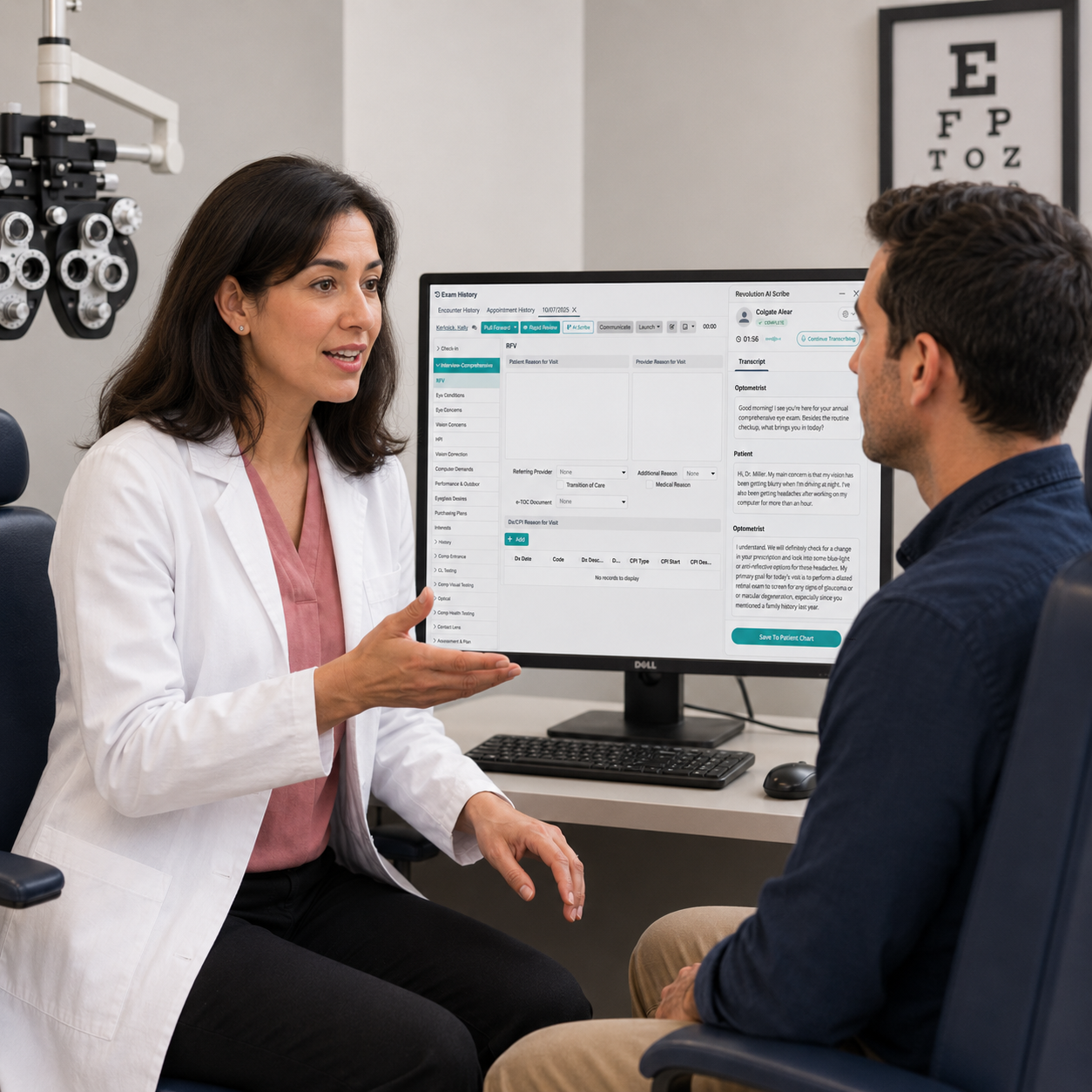
Built directly into RevolutionEHR, AI Scribe launches with one click from the exam screen. Your OD speaks naturally through the encounter, and the tool captures commentary and populates data fields for the 10 most common tests in real time.
The OD reviews, approves, and moves on to the next patient with the chart already closed. That change improves the experience for everyone who comes after.
What Changes for Front Desk
When charts close on time, the information your front desk needs is available at checkout. Prescription questions get answered before the patient leaves, and patients walk out with complete documentation. Your staff isn't left managing follow-up calls that should never have been necessary.
What Changes for Billing
Incomplete or delayed encounters are one of the most consistent sources of billing friction. When documentation closes during the visit, your billing team starts the next day with a clean queue. Yesterday's encounters are already sorted.
For a practice trying to keep revenue moving, that's a compounding advantage.
What Changes for Your Techs
Technicians have a natural handoff point at the end of their work, and documentation delays push that point back. With AI Scribe capturing notes as the OD speaks, the exam room keeps its rhythm and the handoff happens when it should.
The Evidence Is Getting Hard to Ignore
Research from Mass General Brigham found that ambient AI documentation produced a 21.2% reduction in burnout among clinicians who used it. Their chief digital officer put it plainly: No other single intervention in the field has matched that result.
The improvement came from addressing burnout's most persistent driver, the feeling that documentation is always one step behind, no matter how hard you work.
The financial case follows naturally. Burnout drives turnover, and turnover is expensive. Replacing a medical assistant runs roughly $14,000, not counting lost productivity or the patient relationships disrupted by any departure.
The impact here shows up clearly in the data.

AI ambient documentation tools have delivered burnout reductions in the range of 13 to 21 percentage points. Many organizations report saving 30 to 40 minutes per clinician per day and reducing after-hours documentation.
There’s still limited peer-reviewed data specific to optometry, but the underlying workflow is the same. The way documentation creates friction in primary care mirrors what happens in eye care practices.
For most practices, the decision comes down to impact. Preventing even one staff departure by reducing documentation burden can offset years of investment in tools like AI Scribe.

What to Watch in the First 30 Days
When you add AI Scribe to your practice, start by tracking your staff's experience of the day, not chart completion metrics.
Ask them a few direct questions:
- Are we fielding fewer end-of-day callbacks about incomplete orders or prescriptions?
- Are encounters closing same-day, or are we still starting mornings with open charts from yesterday?
- Does the checkout process feel less rushed?
Their answers will tell you all you need to know about actual impact. The goal is a practice that ends the day with the work done.
A Note on What AI Scribe Won't Do
AI Scribe in RevolutionEHR handles the 10 most common exam tests. The OD's commentary is captured and populates the relevant data fields, but the OD reviews and approves everything before it goes into the record.
Clinical judgment stays with the clinician. The OD is still running the exam, making the clinical calls, and signing off on every entry.
What changes is the clerical work that used to keep your OD at the keyboard well after the exam is finished. AI Scribe helps bring documentation back into the visit so your team can work with complete information from start to finish.
When that happens, everything else starts to run the way it should.
"There is literally no other intervention in our field that impacts burnout to this extent."– Chief Digital Health Officer, Mass General Brigham
See AI Scribe in Action With RevolutionEHR
Ready to make the magic of AI Scribe work for your team? Book a demo to arrange your free personalized demo.


FAQs
How does delayed documentation contribute to burnout in an optometry practice?
What is AI Scribe in RevolutionEHR?
How can AI Scribe help front desk staff?
How does AI Scribe support billing workflows?
Does AI Scribe replace the clinician’s judgment?

Backed by deep expertise in optometry and a commitment to the success of eye care practices, RevolutionEHR offers insights and perspectives designed to help providers streamline operations, enhance patient care, and thrive in a changing healthcare landscape.