

5 Signs Your Patient Balance Process Is Costing More Than You Think

- Remove the current class from the content27_link item as Webflows native current state will automatically be applied.
- To add interactions which automatically expand and collapse sections in the table of contents select the content27_h-trigger element, add an element trigger and select Mouse click (tap)
- For the 1st click select the custom animation Content 27 table of contents [Expand] and for the 2nd click select the custom animation Content 27 table of contents [Collapse].
- In the Trigger Settings, deselect all checkboxes other than Desktop and above. This disables the interaction on tablet and below to prevent bugs when scrolling.
Patient balances rarely become a collection problem overnight. The cost starts earlier, when staff make repeated follow-up calls, balances sit unpaid, statements go out, and patients encounter unnecessary friction when trying to pay.
For optometry practices, those delays affect more than cash flow. They create administrative work, make revenue less predictable, and pull staff attention away from patients.
Here are five signs that your current patient balance process may be creating more work than it should.
Why Patient Balance Collection Starts Before Collections
Patient balance collection starts before an account becomes overdue. It includes how financial responsibility is identified, communicated, collected, and followed up throughout the patient journey.
Not every balance can be finalized before checkout. Insurance processing may determine the final amount owed after the appointment. But practices can reduce delays by collecting known amounts at an appropriate point in the visit and making later balances easy for patients to understand and pay.
The goal is not to pressure patients. It is to prevent avoidable delays and give them a clear path to resolve what they owe.
Sign #1: Staff Spend Too Much Time Chasing Payments
Your staff should not have to function as a collections department throughout the day.
Yet patient balances can create a long list of manual tasks:
- Reviewing aging reports
- Calling patients about outstanding balances
- Reprocessing failed payments
- Answering questions about old statements
- Taking card payments over the phone
- Documenting follow-up attempts
- Reconciling payments across separate systems
Each task may seem minor on its own. Together, they can consume hours that could be spent helping patients, supporting providers, or keeping the day moving.
The burden is especially noticeable in smaller practices, where the same employee may handle check-in, phones, insurance questions, checkout, and billing follow-up.
Ask how often your team has to manually touch a balance after the patient leaves. Can the patient pay without calling the office? Can staff see the payment status easily? Are employees switching between systems or repeating work?
A high number of manual touchpoints is a strong sign that the workflow itself needs attention.
Sign #2: Your Accounts Receivable Keep Aging
An aging balance is not just delayed revenue. It is unfinished work.
When patient balances remain outstanding for 30, 60, or 90 days, the practice may continue monitoring the account, contacting the patient, sending statements, and documenting each attempt.
Growing patient accounts receivable can also make it harder to forecast cash flow and determine which balances actually require attention.
If balances routinely age, look upstream before assuming the billing team simply needs to work harder.
Ask:
- When is the patient first told about the balance?
- How quickly can the patient pay after receiving that information?
- Are follow-up steps consistent?
- Can staff easily identify balances that require action?
The earlier the practice identifies payment friction, the more opportunities it has to prevent balances from becoming difficult to collect.
Sign #3: Patients Receive Multiple Statements Before Paying
Every additional statement represents more than a mailing. It can mean more staff review, printing or vendor costs, postage, patient questions, address corrections, returned mail, and payment reconciliation.
Multiple statements may also indicate that the patient is encountering friction.
The patient may not understand the balance. They may intend to pay but lack a convenient option. A delayed bill can also be confusing when the appointment occurred weeks earlier or involved both routine vision care and medical eye care.
Patient responsibility may include copays, deductibles, coinsurance, noncovered services, optical purchases, or balances determined after claim processing. Whatever the source, the payment experience should make it easy to understand what is owed and what to do next.
A more useful question than "Did we send a statement?" is:
Did the patient receive a clear and convenient opportunity to pay?
Sending a statement communicates a balance. It does not necessarily mean the payment process is working well.
Sign #4: Traditional Collections Have Become Part of Your Normal Workflow
Traditional collections can be appropriate when a balance remains unresolved after the practice has made reasonable efforts to collect it.
The warning sign is not that your practice ever uses collections. It is that sending accounts to collections has become a routine and expected part of the revenue cycle.
When balances regularly reach that stage, look upstream.
Did patients have earlier opportunities to understand their responsibility, ask questions, receive a reminder, use a convenient payment method, or complete payment without calling the office?
By the time an account reaches external collections, the practice has already absorbed much of the administrative burden. Payment has been delayed, staff have followed up, and the patient relationship may have become more difficult.
The strongest collection strategy is not simply recovering more old balances. It is reducing the number of balances that become old in the first place.
Sign #5: Your Payment Process Is Not Connected to the Patient Journey
Payment collection is often treated as a separate billing function. In reality, it is part of the patient experience.
When payment tools are disconnected from the rest of the workflow, staff may need to enter information more than once, search across systems, or manually update an account after a payment is made.
Patients feel the disconnect too. They may be able to schedule online and receive digital reminders, then find that paying an outstanding balance requires calling the practice during business hours.
That creates friction for everyone.
A more connected payment workflow should make payment opportunities available at appropriate points, keep payment status visible to the team, reduce duplicate work, and give patients convenient ways to pay.
This does not mean every balance must be collected before the patient leaves. Insurance processing can change what is ultimately owed.
It means payment should remain connected to the systems and communications the practice already uses.
What a More Proactive Patient Payment Workflow Looks Like
A proactive workflow focuses on preventing unnecessary delays rather than waiting for balances to become collection problems.
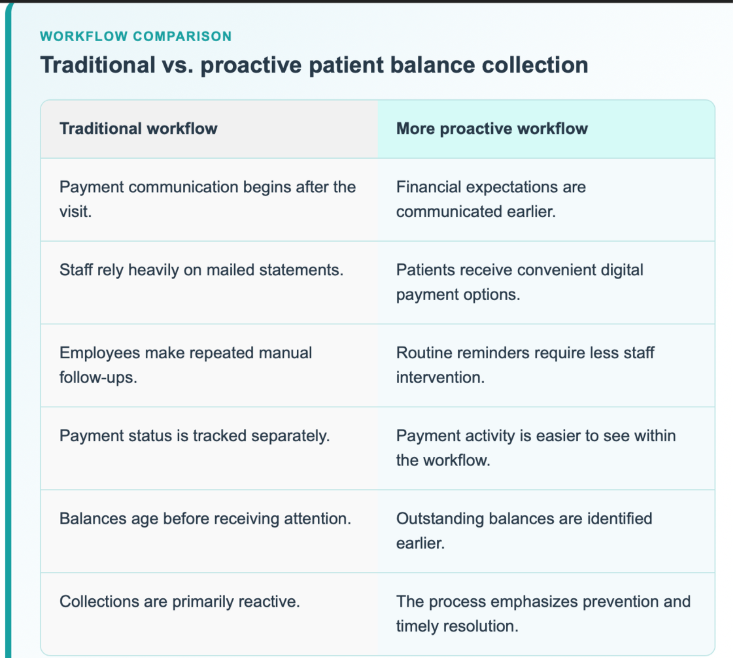
Bringing Payments Closer to the Visit
Practices cannot always determine final patient responsibility at checkout. Medical insurance and vision insurance may process services differently, and claim adjudication may create a balance after the appointment.
But practices can reduce the distance between the visit and payment by communicating known amounts earlier, offering convenient payment options, sending timely balance notifications, and keeping payment activity visible to the team.
For practices using RevolutionEHR, RevPay can support a more connected patient payment workflow. Rather than treating payment collection as a separate administrative process, practices can evaluate how payments fit alongside scheduling, insurance, checkout, patient communication, and revenue cycle management.
The value is not simply accepting a payment. It is reducing the friction surrounding that payment for both the patient and the practice.
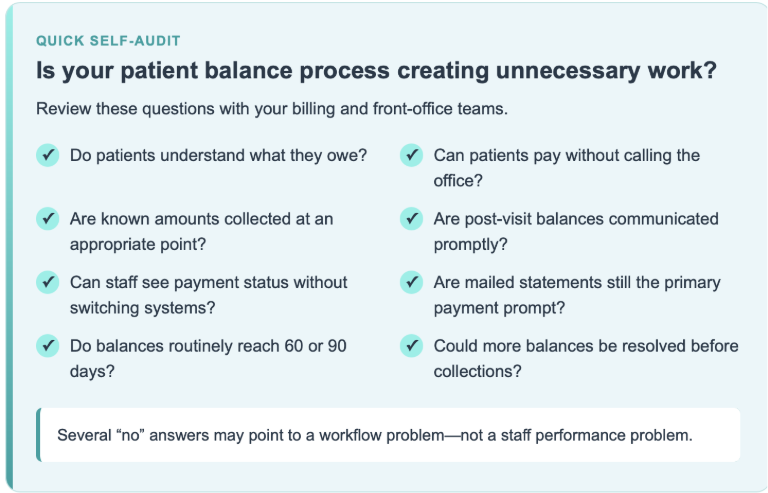
Patient Balance Process Checklist
Use these questions to identify where your payment workflow may be creating unnecessary work:
- Do patients understand what they owe?
- Can patients pay without calling the office?
- Are known amounts collected at an appropriate point in the visit?
- Are post-visit balances communicated promptly?
- Does staff repeatedly enter or reconcile the same information?
- Can employees see payment status without switching systems?
- Are mailed statements still the primary payment prompt?
- Do balances routinely reach 60 or 90 days?
- Are collections agencies receiving accounts that might have been resolved earlier?
- Is your process consistent across staff members or locations?
Several “no” answers do not necessarily mean the team is performing poorly. They may indicate that the workflow itself needs attention.


The Cost of Waiting Is More Than the Unpaid Balance
An unpaid patient balance costs more than the amount sitting on the aging report. It can create repeated staff work, delayed revenue, additional patient communications, and unnecessary friction.
No payment process will eliminate every outstanding balance. Insurance delays, financial hardship, billing questions, and other circumstances will still require individual attention.
Start by looking at where balances slow down, how often staff have to intervene, and whether patients have a clear path to pay. The goal is not to eliminate every outstanding balance. It is to keep preventable balances from becoming collection problems in the first place.
See how RevPay can help bring patient payments into a more connected RevolutionEHR workflow.
FAQs
What is patient balance collection?
When should a practice collect patient balances?
Why do patient balances become harder to collect over time?
How can practices reduce manual patient payment follow-up?
When should a patient balance be sent to collections?

Digital marketing and brand visibility professional with a decade of experience building content that improves discoverability, strengthens trust, and supports growth for healthcare and health tech brands. Patient-first, and a firm believer that clarity beats jargon.