

The 14 Most Popular Tools Optometrists Use: A Beginner's Guide

- Remove the current class from the content27_link item as Webflows native current state will automatically be applied.
- To add interactions which automatically expand and collapse sections in the table of contents select the content27_h-trigger element, add an element trigger and select Mouse click (tap)
- For the 1st click select the custom animation Content 27 table of contents [Expand] and for the 2nd click select the custom animation Content 27 table of contents [Collapse].
- In the Trigger Settings, deselect all checkboxes other than Desktop and above. This disables the interaction on tablet and below to prevent bugs when scrolling.
Optometrists use a wide range of tools to evaluate vision, check eye health, diagnose eye conditions, and help patients find the right prescription.
For optometry students, future optometric assistants, or anyone curious about the field, learning the basic equipment is a great first step toward understanding what happens during a comprehensive eye exam.
Below are some of the most common tools used in optometry practices, what they do, and why they matter.
14 Recommended Tools for Optometry
Common tools optometrists use include phoropters, slit lamps, tonometers, autorefractors, retinoscopes, ophthalmoscopes, visual acuity systems, trial lenses, lensometers, corneal topographers, visual field analyzers, OCT devices, pupillometers, and pachymeters. These tools help optometrists measure vision, determine prescriptions, evaluate eye pressure, examine eye structures, and monitor ocular health.

1. Phoropter
A phoropter is one of the most recognizable tools in an optometry exam room. It is placed in front of the patient’s eyes while the optometrist switches between lenses to determine the clearest prescription.
This is the tool behind the classic “Which is better, one or two?” part of the eye exam.
Best for: Finding glasses and contact lens prescriptions
2. Slit Lamp
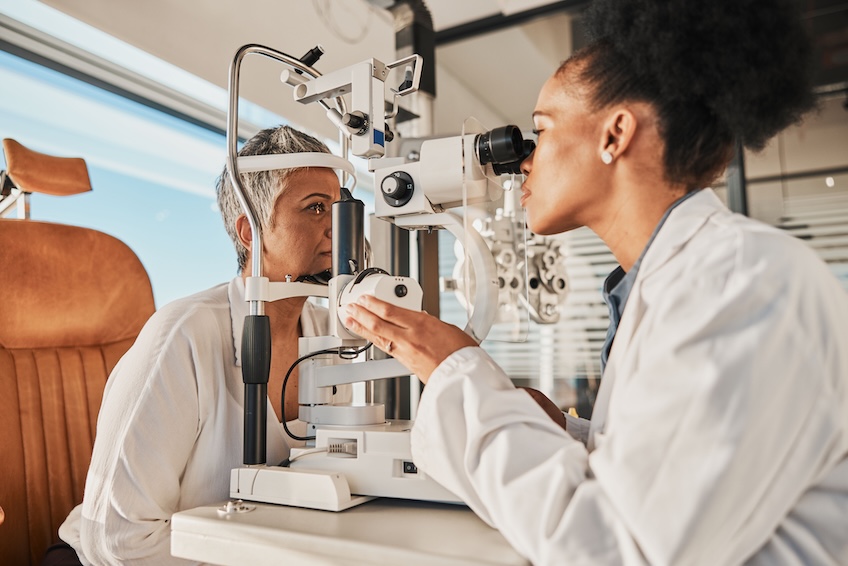
A slit lamp is a microscope with a bright, narrow beam of light that allows the optometrist to examine the front structures of the eye, including the eyelids, cornea, iris, and lens. With additional lenses, it can also help evaluate the back of the eye.
Best for: Detailed eye health exams

3. Tonometer
A tonometer measures intraocular pressure, or pressure inside the eye. This is especially important for glaucoma screening and ongoing glaucoma management. Common types include non-contact “air puff” tonometers, handheld tonometers, and Goldmann Applanation Tonometers (the "gold standard" in measuring intraocular pressure (IOP) to diagnose and manage glaucoma).
Best for: Eye pressure checks and glaucoma screening

4. Autorefractor
An autorefractor gives an automated estimate of a patient’s refractive error. It does not replace the full refraction process, but it gives the eye care team a useful starting point before fine-tuning the prescription.
Best for: Quick starting measurements for prescriptions
5. Retinoscope
A retinoscope is a handheld instrument that shines light into the eye to help the optometrist objectively estimate a patient’s prescription. It is especially useful for children, for patients who cannot give reliable responses, and for complex refractions.
Best for: Objective prescription measurements

6. Ophthalmoscope
An ophthalmoscope is used to look at the back of the eye, including the retina, optic nerve, and blood vessels. Direct ophthalmoscopes are handheld, while indirect ophthalmoscopy provides a wider view of the retina.
Best for: Checking the retina and optic nerve

7. Visual Acuity Chart or Digital Acuity System
A visual acuity chart measures how clearly a patient can see at a distance. Traditional Snellen charts are still recognized by most people, but many modern practices use digital acuity systems with multiple test options.
Best for: Measuring distance vision
8. Trial Frames and Trial Lenses
Trial frames and lenses allow optometrists to manually test different prescription combinations. They are especially helpful for teaching, low vision evaluations, specialty prescribing, and situations where a more hands-on approach is needed.
Best for: Manual refraction and training
See trial lenses sold on Amazon.
9. Lensometer
A lensometer measures the prescription in an existing pair of glasses. Optometric assistants often use this tool when a patient brings in current eyewear, helping the doctor compare old and new prescriptions.
Best for: Reading glasses prescriptions
10. Keratometer or Corneal Topographer
A keratometer measures the curvature of the cornea, while a corneal topographer creates a more detailed map of the corneal surface. These tools are important for contact lens fitting and for identifying irregular corneal conditions such as keratoconus.
Best for: Contact lens fitting and corneal measurements
11. Visual Field Analyzer
A visual field analyzer checks a patient’s peripheral vision. This tool is commonly used to detect and monitor glaucoma, neurological conditions, and other issues that can affect side vision.
Best for: Peripheral vision testing
12. Optical Coherence Tomography, or OCT
OCT is an advanced imaging tool that captures detailed cross-sectional images of the retina and optic nerve. It is commonly used to help diagnose and monitor glaucoma, macular degeneration, diabetic eye disease, and other retinal conditions.
Best for: Advanced retinal and optic nerve imaging
13. Pupillometer
A pupillometer measures the distance between the pupils, often called PD. This measurement is important when ordering glasses because it helps ensure the lenses are properly centered.
A pupillometer helps ensure lenses are centered correctly in the frame, which is especially important for progressive lenses, high prescriptions, and reducing visual discomfort.
Best for: Measuring pupillary distance, or PD, for accurate eyeglass lens placement
14. Pachymeter
A pachymeter measures corneal thickness. This can be useful in glaucoma evaluation, pre-surgical testing, and certain corneal conditions.
A pachymeter is commonly used in glaucoma evaluations, LASIK or other refractive surgery screenings, and the monitoring of corneal conditions. Corneal thickness can affect how eye pressure readings are interpreted.
Best for: Measuring corneal thickness


Ready to See How Optometry Practices Stay Organized?
Learning the tools of the exam room is only one part of understanding modern optometry. Behind the scenes, practices also rely on efficient EHR and practice management software to document exams, manage workflows, and support better patient care.
If your college or school is preparing future optometrists for real-world practice, see how RevolutionEHR can support hands-on learning.
Schedule a RevolutionEHR demo for colleges and schools.

FAQs
What tools do optometrists use during an eye exam?
What are the main types of optometry tools?
What is the difference between an autorefractor and a phoropter?
What tools are most important for optometry students to learn?
What tools do optometric assistants commonly use?

Backed by deep expertise in optometry and a commitment to the success of eye care practices, RevolutionEHR offers insights and perspectives designed to help providers streamline operations, enhance patient care, and thrive in a changing healthcare landscape.